Pencil fandom becoming mainstream? The Guardian has a discussion about contemporary pencil usage.
Personally I don't consider myself to be a "commodity fetishist" when it comes to pencils, but I enjoyed this article and the comments beneath. I'll be commenting later, when I get back from an engagement I have this evening....
Cult Pens gets a few mentions in the article and the comments, as does Dave's Mechanical Pencils. Nice to see pencils get a discussion.
It would be great if some of the pencil bloggers could contribute to the comments, too.
Tampilkan postingan dengan label cheap pencils. Tampilkan semua postingan
Tampilkan postingan dengan label cheap pencils. Tampilkan semua postingan
"Alternative" Uses for a Pencil 2
No pictures this time, but today I used a pencil to mark a ballot paper at my local polling station. Today is an election day in much of the United Kingdom, with national government elections in Scotland, Wales and Northern Ireland, and local authority elections in England. I voted in none of those; instead I voted in a referendum held concurrently, the first referendum held across England since 1975.
The referendum was to vote on whether or not to introduce a new voting system in Parliamentary elections. I won't go into the details of our electoral system but the choice was between retaining the current First Past the Post system and introducing an Alternative Vote system.
Readers may be slightly surprised to see that the voting process in Britain is still very simple. I mark the ballot with a pencil according to my preference with an X in the box. And that's it. No machines are used in the count; we still employ teams of people to count the votes at town halls across the land.
So there's your alternative use for a pencil: democracy. Not bad for a cheap HB stub on a bit of string....incidentally I voted for AV.
The referendum was to vote on whether or not to introduce a new voting system in Parliamentary elections. I won't go into the details of our electoral system but the choice was between retaining the current First Past the Post system and introducing an Alternative Vote system.
Readers may be slightly surprised to see that the voting process in Britain is still very simple. I mark the ballot with a pencil according to my preference with an X in the box. And that's it. No machines are used in the count; we still employ teams of people to count the votes at town halls across the land.
So there's your alternative use for a pencil: democracy. Not bad for a cheap HB stub on a bit of string....incidentally I voted for AV.
Linex WP100 HB Pencil

Denmark is known for many things: bacon, the world's oldest national flag, and Lego spring immediately to mind. It has a long-established stationery industry which has provided the world with Viking pencils, and of course Bantex everything else. Less well-known however, is the Linex company. This is rather surprising as it was, according to the company's own website, established in 1935. After a period of ownership by Bantex in the 1990s, it was spun off again as an independent company by Groupe Hamelin, which acquired Bantex around the turn of this century.
Linex manufactures well-made plastic stationery goods, principally rulers, stencils and templates, and geometry tools. I own a few of them, including a very nice circle template, a metal eraser shield and a 5mm lettering stencil. Linex also specialises in tools for marine navigation. Woodcased pencils appear to be a sideline, and I suspect production of the Linex WP100 (pictured above, with apologies for the poor quality) is sub-contracted to another company. I can see no evidence either on the net or on the pencils themselves that the WP100 is made in Denmark; I guess it is made in China. Neither have I been able to find a review of the WP100 on the internet, so I believe this is the first online review of this product, which I bought from The Stationers That Shall Not Be Named some time in 2009.
The WP100 is a standard office/school woodcase pencil and is available in five grades, from 2H to 2B. It is finished in a distinctive bottle-green lacquer, which is finished off with fine silver lines, a white band and a black end-cap. (Green is the Linex company colour.) It is the same length as a standard pencil, but is noticeably thicker in the hand; at least a millimetre or two thicker than a Staedtler Noris, for example. Whether this is due to the thickness of the paint used, or wider slat of wood, I do not know. You may have trouble locating this pencil, and I certainly know of only one retailer which carries it, but if you can find it for sale, this pencil may be worth a punt.
The WP100 is quite cheap, and occupies the middle ground in pencil cost: it costs GBP0.45 in the local stationer's. For this I got a pencil made from cedar, and one that will withstand sharpening with my KUM steno sharpener. However, after a few days using this exclusively at work, I found a number of drawbacks with the WP100. First, the finish is not as good as it could be. The paint may be thick, and show no sign of woodgrain, but the silver lines are unevenly applied, and the white band is at a slight angle on one of my examples. The white band is on another pencil is not even and there’s a bulge in the paint (see below).

In the hand I found the corners dug into my fingers in a similar way to the Tombow Mono 100 I reviewed a while back, and the extra girth of the pencil contributed to the general discomfort of using this pencil.
However the weakest part of this pencil is the lead. I have HB and B examples of this pencil. The B is actually not too bad; it is dark and writes well on paper, though it feels less gritty than the HB. The HB I used was more troublesome because there must have been a problem with mixing the lead. In addition to the grittiness of the lead on the paper, there were also what felt to be lumps of clay in the mix. The line left by the HB pencil occasionally became much lighter, and the lead harder. This was unfortunate because otherwise, it was fairly dark; perhaps as dark as the Stabilo 4908s I reviewed last year. Both erased well with my Stabilo eraser, however.
So, the WP100 is a curate’s egg of a pencil: good in parts, bad in others. The unevenness of the lead is the deal-breaker on this pencil, which is a pity because with a higher-quality lead, this could be a true competitor to the established brands. However, I’ll be sticking to my Staedtler and Faber-Castell pencils.
Goodies
Today was the day of my town's annual Lions Christmas Fair. This is held in the local Corn Exchange, and is used by the townsfolk to recycle stuff. The quality of much of it is surprisingly good and the fair is a chance to pick up some bargains and Christmas presents. Sure enough I managed to bag a few goodies myself including:
The Olympia looks well-used; it has a Swindon dealer's decal (complete with five-digit phone number), not to mention a correcting fluid stain, which has subsquently been lined with blue ball-point, presumably by a bored typist, or perhaps a novelist. This brings my typewriter "collection" to two: the other being a 1970s Olympiette, a present from my mother-in-law. My wife thinks I am mad to entertain such beasts when I already possess a PC, but sometimes it is nice to get the manual typewriter out and bash out a few lines of meaningless prose. I have an idea of typing notes onto 3"x5" cards - have another look at the picture which adorns this blog. This would be useful if and when I ever get around to persuing academic research again, perhaps for a master's degree. After all, if it's good enough for the historian David Starkey, it's probably good enough for me. I use index cards a lot to write down to-do lists or just notes in general, because I don't like Post-it notes much. (The paper is crap and it doesn't take fountain pen ink at all well.) The 3"x5" card is an ideal size, I think; big enough to write quick notes on, but small enough to fit inside a diary, Filofax or book. I keep a bunch of them held together with a large clip.
Obviously, a good day; and I'll be back again next year.
- a Marksman wooden ruler (which was made in England, but graduated only in metric units)
- a yellow-and-orange Fila Temograph H pencil (stamped "Florence Italy") which looks completely unused
- a few other pencils including a no-name primrose yellow round pencil and two Conté Evolution HBs
- a black plastic 3"x5" card index box full of blank cards and indexed dividers
- a genuine Anglepoise fully-articulated desklamp complete with low-energy bulb
- and last but not least, an Olympia SM-3 portable (if you have a team of porters) mechanical typewriter in grey, complete with carry case.
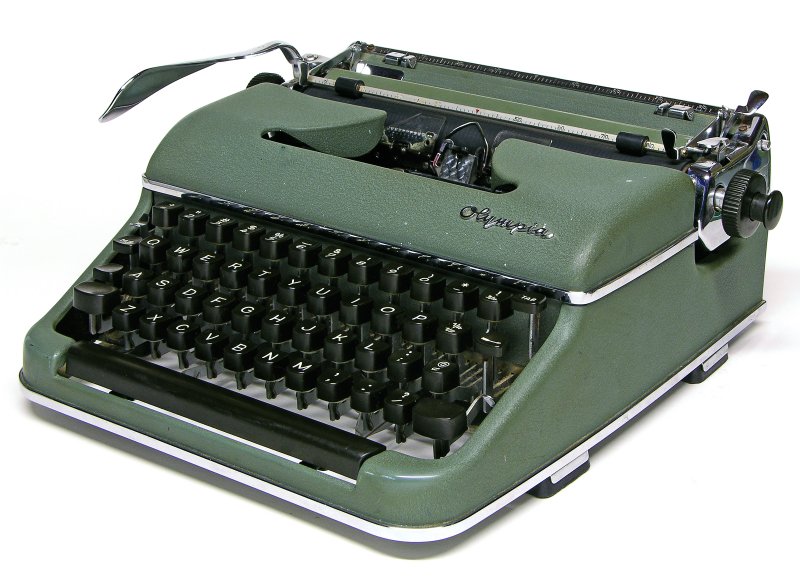
The Olympia looks well-used; it has a Swindon dealer's decal (complete with five-digit phone number), not to mention a correcting fluid stain, which has subsquently been lined with blue ball-point, presumably by a bored typist, or perhaps a novelist. This brings my typewriter "collection" to two: the other being a 1970s Olympiette, a present from my mother-in-law. My wife thinks I am mad to entertain such beasts when I already possess a PC, but sometimes it is nice to get the manual typewriter out and bash out a few lines of meaningless prose. I have an idea of typing notes onto 3"x5" cards - have another look at the picture which adorns this blog. This would be useful if and when I ever get around to persuing academic research again, perhaps for a master's degree. After all, if it's good enough for the historian David Starkey, it's probably good enough for me. I use index cards a lot to write down to-do lists or just notes in general, because I don't like Post-it notes much. (The paper is crap and it doesn't take fountain pen ink at all well.) The 3"x5" card is an ideal size, I think; big enough to write quick notes on, but small enough to fit inside a diary, Filofax or book. I keep a bunch of them held together with a large clip.
Obviously, a good day; and I'll be back again next year.
Stationery Archeology 3

Third in this series, I'm really excited by this find. It is a Staedtler Shorthand pencil, HB and made in Great Britain. I found this on 22 October 2010 in a stationer's in Southampton. It is salmon-pink with a white band and a red painted end-cap, and the lettering (stamped in red) says:
GREAT BRITAIN STAEDTLER SHORTHAND JET BONDED
I love the stylised typography of the words "Staedtler" and "Jet Bonded". The model number is obscured by the price label - but I think this was model number 114. This pencil is a bit scuffed from years languishing unloved and unwanted in the stationer's pencil rack, but I'd like to think that has now ended and it has found a welcome in my modest collection. I've not tried writing with this pencil, so don't ask yet how well it writes.
I did not even know that Staedtler made stenographers' pencils here in the UK, so this was a delightful surprise for me. This clearly is one of the predecessors of the rare-as-hens'-teeth Stenofix. As it happened, I found this just around the corner from where I used to work, and shared an office with a shorthand typist called Joan. That office is now a hairdresser's.
This pencil was a bargain, as it cost me only 50p! I feel like I've just unearthed Sutton Hoo. What a shame they only had one in the rack, as I'd have had the lot. Never mind, I also found a somewhat beaten-up made-in-GB Staedtler tradition 2H too.
Stabilo Swano 4907

Quick review time, again: this one is for a pack of four Stabil Swano 4907 pencils. I bought this pack in a branch of Ryman's (a chain of stationers' here in England) for £1.69, which is about 43 pence per pencil.
They come in bright - almost livid - fluorescent colours. The four colours used - yellow, green, pink and orange - match the four basic colours used by Stabilo for their famous Boss highlighter pens. Each pencil is armed with an eraser tip in the same colour as the paint on the pencil, attached by an aluminium ferrule.
In the hand, the Swano handles like any other hexagonal pencil. The wood is good quality and sharpens well, and the eraser does its job adequately enough. The edges are slightly rounded, so it does not dig into fingers. The painting is nicely done and markings are understated; no foil blocking here, just the name, barcode and some serial numbering, but there is no country of origin information printed. I guess these pencils are made in Stabilo's factory in the Czech Republic, but if anyone knows better, please let me know in the comments.
I used one of these pencils for a day or so to write notes at work. The lead is a dark and soft HB. On paper it does not feel scratchy, nor very smooth, but gritty; I can liken the feel of it to writing on sandpaper. It's not unpleasant, but it does not glide on the paper, if that is what you want. This utilitarian pencil is clearly designed for school in mind, and a four-pack should last a whole school year.
In short, the Swano 4907 is a decent-quality pencil that is fun to use but which you would not lose sleep over if it was stolen from your desk in class.
Uni-Ball Kuru Toga

I've not got much time to blog just now but I wanted to post quickly about my new mechanical pencil, a Uni-Ball Kuru Toga which I got recently from Cult Pens. (More technical info about this pencil at that site, but also here and here.) This one is finished in a smart azure blue (one of seven colours Cult Pens sell). I haven't used a mechanical pencil for some time - my Pentel P205 is gathering dust - but this may make me change my mind. The lead is good and dark, even for a 0.5mm width, and the proprietary mechanism inside prevents it from becoming chisel-shaped because it rotates the lead 9° with every contact with the paper. I used this to take notes during a conference with our auditors last week and it worked reliably and of course, never needed sharpening, just an occasional press of the button to advance the lead. I've also been using it in the office to take the copious notes I often have to write.
The Kuru Toga's rotating lead mechanism is, of course, this pencil's main selling point and they display it for all to see under a transparent window section so you can watch it turn as you write. I'm not so convinced by this, and would rather have a sleek, all-blue barrel, but that is a minor point. Eventually other lead widths should become available, but I understand that there are engineering issues to overcome before a 0.7mm model comes out, but if one does I will certainly get one. It would be wonderful to see a 0.9mm and a 0.3mm to complement the 0.5mm.
I don't think this will replace any of my wood-cased pencils as I like them too much, but for pencil writing on the move, this seems to be a fine candidate, and at the price Uni-Ball wants for it in the UK, it is a bargain. The price at Cult Pens is £5.60 and even my local stationers' has this for £5.99. Buy the whole collection - I may well do myself.
Where have all the round pencils gone?

I mean good quality pencils, not the cheap ones you buy as souvenirs. I recently found out about stenographers' pencils such as the Staedtler 101 and the Faber-Castell 9008, which of course do not appear to be available here in the UK. I've seen them advertised on Amazon.de and ebay.de but my German isn't good enough to make enquiries about postage costs to the UK, a pity really because the Staedtler Stenofix looks like a very smart pencil indeed, and I don't mind the fact it's available only in HB.
It seems obvious to me that a circular, rather than hexagonal shape, is more comfortable for long spells of writing, whether it's another chapter of a novel or just some notes taken in a meeting. Yet, none of the top brands appears to offer them any more, or if they do, they sell them only to select places. One has to go cheap to find round pencils, a situation set to continue as the Stenofix and 9008 appear destined for the dustbin of history if anecdotal evidence is to be believed, even when Staedtler still advertises the model on its global website.
Obviously, in an office environment where most people write their own correspondence on PCs, stenographers are an endangered species and the steno pencil also looks set for extinction. Another possible reason for the near-disappearance of steno pencils is the wastage of wood used in production. It seems that for a given slat, nine hexagonal pencils can be cut against eight round pencils. Clearly manufacturers have to pass on this cost to the customer, making a quality round pencil more expensive than its hexagonal competitor. I have some trouble believing this as it would then follow that all cheap, no-name pencils, or souvenir pencils, would be hexagonal too when clearly they are not.
For the "name" manufactuers, operating in a market where the humble pencil is considered a disposable commodity, it would be difficult to charge a premium to recover the extra material costs. For most users, there is no apparent advantage to using a round pencil over other shapes and the manufacturers have no stake in changing that attitude. It is possible now that most pencils are hexagonal because people expect them to be.
Langganan:
Postingan (Atom)