Tampilkan postingan dengan label HB. Tampilkan semua postingan

Dixon Ticonderoga HB Pencil


I begin this review with an old British television clip: the opening credits and introduction of an episode of Roald Dahl's Tales of the Unexpected. Although best known around the world for his children's stories, Dahl also wrote wicked short stories for adults. He did this using the original predecessor of the pencil I review now: the Dixon Ticonderoga. The introduction on this episode of Tales of the Unexpected was typical: Dahl talking to camera from what purported to be his study, fiddling with a pencil as he spoke.

He was particular about the pencils and paper with which he wrote. The Ticonderoga was not, as far as I know, available in Great Missenden, England at the time, and I guess he stocked up during his frequent visits to the USA. Writing sessions would begin with sharpening six pencils, and he would change pencils rather than stop in mid-flow to sharpen a dull point. When I bought the review pencils from Cult Pens, I was tempted to purchase a box of twelve, so that I could put them into a cup and admire them by the dozen. Ticonderogas appear best in bulk: there's a scene in one episode from the last season of Mad Men where Joan Harris is seen extracting a number of them from the false ceiling. I've not had a chance to watch much that season again yet, but the Ticonderoga plays a small, but important role in Season Four. (And I recall another similar scene where Mulder has done the same in The X-Files basement.)

The Ticonderoga, long established as an American-made pencil, is now produced in Mexico and China. The Dixon name is part of the Fila stable of companies (it acquired Lyra a few years ago). It has very little currency here in Europe and until last year I had never even heard of it. When I saw that Cult Pens had begun to stock it however, I was keen to try one for review.


The pencil itself is finished in what might be called US Standard Office Pencil Yellow.  This isn't the golden yellow of the Staedtler Noris; it's closer to the colour of honey, Bath stone or even mustard.  It has a slight reddish cast to it.  Unlike most contemporary pencils, this one bears no barcodes, country of origin stamps or any extraneous marking except the simple "Dixon Ticonderoga 2 HB" in green foil blocking.  The ferrule, stamped from green-painted metal, bears two yellow stripes.  New in the box, it comes unsharpened.  This pencil certainly looks as though it means business.  But how does it write?

Surprisingly well, I found.  If this lead is anything like the old American leads used by Roald Dahl, I can see why they were his favourite pencil for long spells of writing.  The wood is cedar, and the lead is a medium slate-grey shade.  The point lasts a long time and during a week where I used the Ticonderoga exclusively, I found that quite long spells passed between sharpenings.  It sharpened very nicely as well.  The eraser, being a bog-standard pink pearl type, will do at a pinch if nothing else is to hand, but I prefer to use my modern white plastic erasers.

However it was noticeable that some shortcuts have been taken in production.  This is, after all, an everyday office pencil.  Quality control is questionable. One of my pencils was bent; not quite a banana, and not as bad as some examples out there, but certainly deviating from straight and true as can be seen in this photo (taken indoors):


It was this pencil that I used as my sample for this review.

Overall this is a good pencil for everyday use, though the Staedtler Noris 122 is a better overall pencil in my view, largely because of the QC issues. 

Linex WP100 HB Pencil


Denmark is known for many things: bacon, the world's oldest national flag, and Lego spring immediately to mind.  It has a long-established stationery industry which has provided the world with Viking pencils, and of course Bantex everything else.  Less well-known however, is the Linex company.  This is rather surprising as it was, according to the company's own website, established in 1935.  After a period of ownership by Bantex in the 1990s, it was spun off again as an independent company by Groupe Hamelin, which acquired Bantex around the turn of this century.

Linex manufactures well-made plastic stationery goods, principally rulers, stencils and templates, and geometry tools.  I own a few of them, including a very nice circle template, a metal eraser shield and a 5mm lettering stencil.  Linex also specialises in tools for marine navigation.  Woodcased pencils appear to be a sideline, and I suspect production of the Linex WP100 (pictured above, with apologies for the poor quality) is sub-contracted to another company.  I can see no evidence either on the net or on the pencils themselves that the WP100 is made in Denmark; I guess it is made in China.  Neither have I been able to find a review of the WP100 on the internet, so I believe this is the first online review of this product, which I bought from The Stationers That Shall Not Be Named some time in 2009.

The WP100 is a standard office/school woodcase pencil and is available in five grades, from 2H to 2B.  It is finished in a distinctive bottle-green lacquer, which is finished off with fine silver lines, a white band and a black end-cap.  (Green is the Linex company colour.) It is the same length as a standard pencil, but is noticeably thicker in the hand; at least a millimetre or two thicker than a Staedtler Noris, for example.  Whether this is due to the thickness of the paint used, or wider slat of wood, I do not know.  You may have trouble locating this pencil, and I certainly know of only one retailer which carries it, but if you can find it for sale, this pencil may be worth a punt.

The WP100 is quite cheap, and occupies the middle ground in pencil cost: it costs GBP0.45 in the local stationer's.  For this I got a pencil made from cedar, and one that will withstand sharpening with my KUM steno sharpener.  However, after a few days using this exclusively at work, I found a number of drawbacks with the WP100.  First, the finish is not as good as it could be.  The paint may be thick, and show no sign of woodgrain, but the silver lines are unevenly applied, and the white band is at a slight angle on one of my examples.  The white band is on another pencil is not even and there’s a bulge in the paint (see below). 


In the hand I found the corners dug into my fingers in a similar way to the Tombow Mono 100 I reviewed a while back, and the extra girth of the pencil contributed to the general discomfort of using this pencil.

However the weakest part of this pencil is the lead.  I have HB and B examples of this pencil.  The B is actually not too bad; it is dark and writes well on paper, though it feels less gritty than the HB.  The HB I used was more troublesome because there must have been a problem with mixing the lead.  In addition to the grittiness of the lead on the paper, there were also what felt to be lumps of clay in the mix.  The line left by the HB pencil occasionally became much lighter, and the lead harder.  This was unfortunate because otherwise, it was fairly dark; perhaps as dark as the Stabilo 4908s I reviewed last year.  Both erased well with my Stabilo eraser, however.

So, the WP100 is a curate’s egg of a pencil: good in parts, bad in others.  The unevenness of the lead is the deal-breaker on this pencil, which is a pity because with a higher-quality lead, this could be a true competitor to the established brands.  However, I’ll be sticking to my Staedtler and Faber-Castell pencils.

Stationery Archeology 5


Number five in this occasional series is a Staedtler tradition HB pencil stub, which I found when cleaning the dust/cobwebs/other detritus from under the computer desk.  This one celebrates 300 150 years of Staedtler pencils, dating this pencil to 1985 (see second pic). Note the joined D and T on the "EDTLER".  I definitely used this pencil at school.  Apologies for the ham-fisted sharpening as I used a knife, not a sharpener, on this pencil for a DIY job years ago.  (Edited for correct date.)


Goodies

Today was the day of my town's annual Lions Christmas Fair. This is held in the local Corn Exchange, and is used by the townsfolk to recycle stuff. The quality of much of it is surprisingly good and the fair is a chance to pick up some bargains and Christmas presents. Sure enough I managed to bag a few goodies myself including:

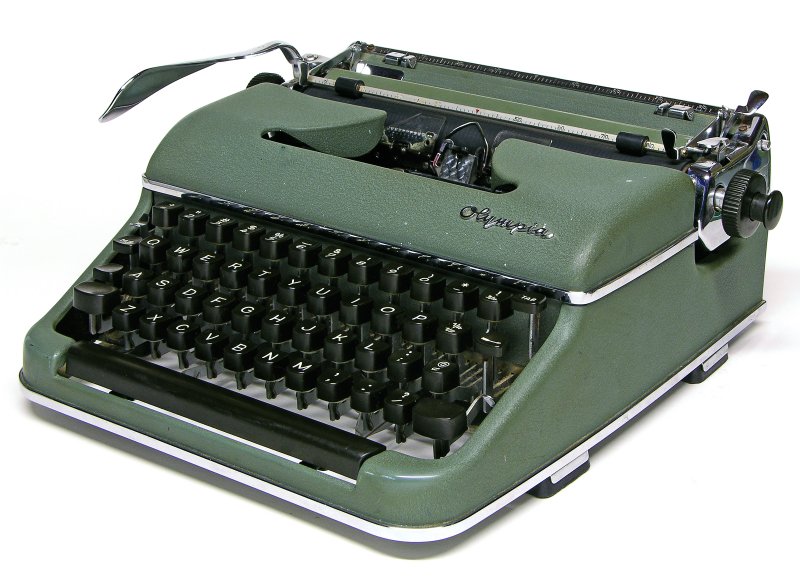
The most expensive items were the lamp and the typewriter, which both set me back a princely 3GBP. The pencils were a giveaway - ie, completely gratis and free. I am delighted with this haul, particularly the typewriter, which I have already played with. The Olympia is in full working order and the ribbon looks fine. I had gone with the intention of getting the desk lamp but as I'm always on the lookout for interesting stationery, I had hoped to find a few other bits and pieces for the collection.

The Olympia looks well-used; it has a Swindon dealer's decal (complete with five-digit phone number), not to mention a correcting fluid stain, which has subsquently been lined with blue ball-point, presumably by a bored typist, or perhaps a novelist. This brings my typewriter "collection" to two: the other being a 1970s Olympiette, a present from my mother-in-law. My wife thinks I am mad to entertain such beasts when I already possess a PC, but sometimes it is nice to get the manual typewriter out and bash out a few lines of meaningless prose. I have an idea of typing notes onto 3"x5" cards - have another look at the picture which adorns this blog. This would be useful if and when I ever get around to persuing academic research again, perhaps for a master's degree. After all, if it's good enough for the historian David Starkey, it's probably good enough for me. I use index cards a lot to write down to-do lists or just notes in general, because I don't like Post-it notes much. (The paper is crap and it doesn't take fountain pen ink at all well.) The 3"x5" card is an ideal size, I think; big enough to write quick notes on, but small enough to fit inside a diary, Filofax or book. I keep a bunch of them held together with a large clip.

Obviously, a good day; and I'll be back again next year.

Stabilo GREENgraph 6003


Another quick review of a Stabilo product, this time their "green" pencil, the GREENgraph 6003. This HB pencil, which comes in eraser-tipped and non eraser-tipped versions, is Stabilo's effort at developing, manufacturing and marketing a pencil which is produced from wood managed in a sustainable way. This pencil, along with others in the Stabilo stable, is designed to conform with Forest Stewardship Council (FSC) rules on woodland management; Stabilo as a company has been registered with FSC since 1998. It claims to be "first FSC-certified writing instruments manufacturer and hence a pioneer in the industry". All well and good, though I have just tried (unsuccessfully) to confirm this. Penciltalk tried to check the Chain of Custody for a review of the GREENlighter highlighting pencil, but found the online documentation to be less-than-helpful.

In any case, this pencil is a conventional hexagonal HB pencil, finished very nicely indeed in a cheerful spring-green colour with white stripes. There's a bit of user info, including the FSC logo to remind the user this is an eco-pencil, but no country of origin information. The reverse has a stock number and barcode. Mine does not have the eraser.

This pencil writes in similar fashion to the Stabilo Swano 4907 I reviewed a while back. It's OK, not unpleasant, though it has that grittiness I mentioned before. It's fairly dark and leaves a dense line on paper; it's slightly lighter and firmer than a Staedtler tradition HB, but without the smoothness of the latter. In the hand, it's actually quite comfortable, though I did not use it for extended writing. I've put mine in my bag as an everyday pencil, which I feel this is. It's really a competitor to the Staedtler Noris, and is a good quality, workaday pencil. Stabilo has produced a nice one here, and I'd be happy to own and use more in the future. This one cost me 50p in a stationer's here in England (no, not the one I complained about recently). I reckon this could be difficult to find as it struggles to find shelf-space in the shops; most stationers here sell either Staedtler or Derwent.

In summary, then: a good everyday pencil, though still more expensive than a Noris.


Stationery Archeology 3


Third in this series, I'm really excited by this find. It is a Staedtler Shorthand pencil, HB and made in Great Britain. I found this on 22 October 2010 in a stationer's in Southampton. It is salmon-pink with a white band and a red painted end-cap, and the lettering (stamped in red) says:

GREAT BRITAIN STAEDTLER SHORTHAND JET BONDED


I love the stylised typography of the words "Staedtler" and "Jet Bonded". The model number is obscured by the price label - but I think this was model number 114. This pencil is a bit scuffed from years languishing unloved and unwanted in the stationer's pencil rack, but I'd like to think that has now ended and it has found a welcome in my modest collection. I've not tried writing with this pencil, so don't ask yet how well it writes.

I did not even know that Staedtler made stenographers' pencils here in the UK, so this was a delightful surprise for me. This clearly is one of the predecessors of the rare-as-hens'-teeth Stenofix. As it happened, I found this just around the corner from where I used to work, and shared an office with a shorthand typist called Joan. That office is now a hairdresser's.

This pencil was a bargain, as it cost me only 50p! I feel like I've just unearthed Sutton Hoo. What a shame they only had one in the rack, as I'd have had the lot. Never mind, I also found a somewhat beaten-up made-in-GB Staedtler tradition 2H too.

Stabilo EASYgraph Right-Handed Pencil


Another quick review, this time of Stabilo's EASYgraph learner's pencil. I bought a twin-pack of these from my local stationer's for £2.00 in September 2010.


This pencil is an over-sized "ergonomic" pencil aimed at the early learner's market and is clearly in competition with Staedtler's Noris Ergosoft range. The idea here is that small children have difficulty holding a conventional pencil when learning to write, but can grip an oversize pencil more easily. Ergonomic pencils usually also feature some form of textured grip surface in addition to the larger diameter. Both pencils have the fashionable triangular cross-section pioneered by Faber-Castell. The Ergosoft pencil has a non-slip finish; the EASYgraph is painted in a cool, dark blue with a greenish tinge, and has a series of gouges in the wood, set at around 45°, to guide fingers to holding the pencil at the right angle when writing on paper. These depressions are set so that the pencil may only be held comfortably in the hand it was designed for, so that a right-hand pencil may only be held for a period in the right hand, and the left-hand model held in the left. The right-hand model has the end dipped in red paint; the left-hand model has a yellow dip. The EASYgraph also has a small panel in which the owner can write their name (presumably in ball-point pen).


The HB lead on this right-hand model has a bit of resistance to it, but leaves a dark, thick line: perfect for small children. It's not too shabby for adults who should by now know how to write, either. Some people have criticised the lead for being scratchy but I've not found this to be the case in the short time I've used this pencil.

I would probably not send my children to school armed with one though, because the EASYgraph stands out a mile compared to a conventional school pencil such as the good old Staedtler Noris HB. It would either attract ridicule from classmates for being a "learner's" pencil or would be stolen or hidden; either would be distressing. Children can also be a bit fussy about their pencils as well, and the ergonomic grip may not suit everyone.

This is one of Stabilo's more interesting pencil designs, and shows that there's still new things to be done with the wood-cased pencil. I doubt that I would use this pencil regularly, but I am glad that Stabilo have taken the risk with this design and I wish them well with it. Oh, and it works well for adults, too.


Stabilo Swano 4907


Quick review time, again: this one is for a pack of four Stabil Swano 4907 pencils. I bought this pack in a branch of Ryman's (a chain of stationers' here in England) for £1.69, which is about 43 pence per pencil.

They come in bright - almost livid - fluorescent colours. The four colours used - yellow, green, pink and orange - match the four basic colours used by Stabilo for their famous Boss highlighter pens. Each pencil is armed with an eraser tip in the same colour as the paint on the pencil, attached by an aluminium ferrule.

In the hand, the Swano handles like any other hexagonal pencil. The wood is good quality and sharpens well, and the eraser does its job adequately enough. The edges are slightly rounded, so it does not dig into fingers. The painting is nicely done and markings are understated; no foil blocking here, just the name, barcode and some serial numbering, but there is no country of origin information printed. I guess these pencils are made in Stabilo's factory in the Czech Republic, but if anyone knows better, please let me know in the comments.

I used one of these pencils for a day or so to write notes at work. The lead is a dark and soft HB. On paper it does not feel scratchy, nor very smooth, but gritty; I can liken the feel of it to writing on sandpaper. It's not unpleasant, but it does not glide on the paper, if that is what you want. This utilitarian pencil is clearly designed for school in mind, and a four-pack should last a whole school year.

In short, the Swano 4907 is a decent-quality pencil that is fun to use but which you would not lose sleep over if it was stolen from your desk in class.

Faber-Castell Grip 2001


For my next review, I thought I would try a competitor to the Staedtler tradition: the Faber-Castell Grip 2001. This pencil is widely available here in England, and is marketed as a high-quality pencil which is produced in two variants: one with an eraser, and one without. This blurb from Cult Pens gives an idea of the market for this design:

The Faber-Castell Grip 2001 series is a traditional wood-case pencil redesig

ned for the 21st century. Winner of numerous design awards, the patented soft-grip zone provides a secure, non-slip grip, while the ergonomic triangular shape aids tireless writing and drawing.

The eraser-tipped version costs 99 pence in my local WHSmith’s, an

d the non-eraser version (the more common of the two) costs 89 pence, which is about half as much again as the Staedtler tradition. My local WHSmith sells this pencil only in HB, though a quick check on Cult Pens shows it to be available in up to five grades: 2B, B, HB, H and 2H. This suggests to me that the Grip is really optimised for writing, rather than drawing.

The Grip is a striking-looking pencil. For one thing it has a triangular section, not hexagonal, is finished in a smart silver-grey matte lacquer, and sports 26 rows of raised dots painted on in black along each side of the barrel. Their purpose is to provide a non-slip surface for the user. On the non-eraser version I used, the end-cap is painted in a gloss gull-grey. The shade of the end-cap varies from black for the 2B to a light grey for the 2H. The lettering (which occupies only two sides of the pencil) is crisp and the barcode is tastefully printed and unobtrusive. The eraser variant sports a ferrule and eraser in black, to match the lettering.

The wood used is not cedar, but I am not sure what it could be. It has a pronounced grain with easily visible pores, and there is no odour from it. In my KUM sharpener it sliced the wood very easily.

I used this pencil exclusively for a few days, and my overall impression is that this is indeed a quality pencil for writing. The HB lead is lighter in colour than Staedtler’s, and requires sharpening less frequently. For example, during a two-hour meeting at work I wrote some five sides of notes and needed to sharpen the Grip only once. The point stays sharp longer, and even when it has worn down it still lays down a good, legible line. It is not so prone to smearing as the Staedtler HB, nor to breaking; using my KUM sharpener I could get a very sharp point which would not yield under moderate writing pressure. Even when the point has worn down, and provided I did not press too much into the paper, it would leave a thicker, though still silvery, line. F-C’s HB standard is harder than Staedtler’s, for example. I would estimate that F-C’s HB is at least one if not two grades harder than Staedtler’s so the HB on a Grip 2001 would equate to a Staedtler H.

The triangular grip is reasonably comfortable, but I am not sure it is any more so than a traditional hexagonal pencil. However the main problem I experienced using the Grip was that the raised dots would dig into my fingers, so that after a fairly short period of time I would feel some discomfort in my writing hand where the pencil rests on my middle finger. This is not a problem for writing notes but for extended periods I think it would be. To be honest the Grip idea seems to me to be a gimmick, a way of differentiating this design of pencil from its competitors. I do not have a problem with slippery pencils, but I find the Grip to be uncomfortable after a while.

Furthermore I wonder if Faber-Castell has practical difficulties manufacturing this model. Close inspection of the few Grip pencils I have, shows the dots to be unevenly applied. Some are rounder and more pronounced than others, whilst some are not even full circles, but have a slice taken out of one side.


But any gripes I may have are very minor. Overall this is a high quality pencil – and a very modern one, too. It is not a favourite of mine because of the comfort issue which I mentioned above, which is odd considering that this pencil is marketed as one which can be used for long periods. Its price puts it almost in the premium pencil class – nearly as much as the Mars Lumograph, for example, or F-C’s own 9000 series. I don’t think it’s quite as good as that and I would rather use a 9000, but this is still a very nice pencil for the money and well worth trying.

Staedtler tradition HB


I thought that I would begin the reviews with an unsung hero of the pencil world, a pencil which, if not quite ubiquitous here in the UK, is probably the most widely-available: the Staedtler tradition HB.

This pencil - at least in its 110 form without an eraser on the end - is pretty much the benchmark in the UK today. (The 112 model which has the eraser at the back, is less commonly seen though recently I bought one in Ryman's.)

Many other pencils are deemed to be higher quality but those aren't often found in your local newsagent's, or stationer's. These cost around 60 pence each (about $1). The closest competitor is the Faber Castell Grip 2001 I suppose, though the tradition is more common. I will get around to reviewing the Grip some time soon.

The tradition is available in 14 grades - from 6B to 6H - though the HB grade is by far the most common, and is used for both drawing and writing. I use it only for writing.

The HB lead is fairly soft and leaves a nice, dark line when pressed hard into the paper. Even when less pressure is used, the line is dark enough to read easily, even when it is sharpened to a fine point. The price paid for this is of course fairly frequent sharpening, and I found I needed to resharpen the tradition once every page or so in my A4 notebook. The lead sharpens up easily, though it will break very easily if you use a lot of pressure. Sharpening is also helped by the quality wood used, which appears to be Californian cedar (though I am no expert on this) which has a tight grain and a pleasant aroma.

After three days in the office using this pencil exclusively to take notes and write messages, I learned to use less pressure and to rotate the barrel of the pencil as I wrote, to keep a smooth even line. It erases very easily with a Stabilo white eraser. Being on the soft side, the lead is prone to smearing, which I found when I leant on my notepad.


Appearance-wise, the tradition is finished in the familiar Staedtler red and black stripes, with gold foil-blocked letters which read:

MADE IN GERMANY STAEDTLER tradition HB

The other side has a barcode and some inventory data on it - sorry, I forgot to take a picture. These are printed on and the barcode is already showing signs of wearing off. Many bemoan the presence of barcodes on contemporary pencils, but I quite like them; if the barcode had been invented fifty or 100 years ago I am sure they would be present on the pencils of yore and today collectors would be proud of them. In the future, the barcodes on today's pencils will be treasured as a feature.The finish is smartly done, with clean demarcations between the stripes. One thing I noticed on the rear end of the pencil however, is that the red and black lacquer show through the white lacquer on this current pencil. Perhaps Staedtler have changed the formulation of the paint? I have some old traditions and a couple of Noris which were made in Great Britain, where the white paint is opaque, not translucent. The lacquer used now is probably less toxic, but I would not know. Anyway, here's a close-up, with the white paint showing a distinct pink tinge:


Production of the tradition has since ceased in Great Britain and Australia, and now it appears to be made only in Germany. Here is an excellent review done by memm on the Bleistift blog which compares traditions made in Germany, GB and Australia. Certainly on the older, made-in-GB pencils I have, the lacquer and overall finish seem to be superior to the pencils of today. I suppose this is due to there being a bit less gold lettering, thinner coats and environmentally-friendly paints used in the finishing. The lead seems to be the same high quality, and the wood on this pencil is as good as the older models.

So, do not overlook the Staedtler tradition HB pencil. It is a fine pencil for the money and should be in everyone's pencil case.